Southeast Asia
Starting a brokerage from Thailand
A founder in Bangkok who wants to run a forex brokerage soon finds that no Thai licence fits. The SEC licenses derivatives firms, but its law leaves off-exchange forex out, and the Bank of Thailand, which runs exchange control, says it has no policy of licensing forex businesses at all. This page reads both regulators' own documents, then the onshore futures route on TFEX and how founders who take a licence elsewhere approach funding and payments.
Thailand licenses no forex platformsFrom this guide's sources
- Bank of ThailandLicence for a forex platformNone offered
- Exchange Control ActPenalty, section 8Up to THB 20,000 or 3 years in prison, or both
- SECUnlicensed derivatives businessUp to THB 300,000 or 3 years in prison, or both
- Bank of ThailandA resident's own transfers to a foreign brokerUSD 5 million a year
Figures and rows from this guide's own sources. Sample market data, sample clients and sample brands. "Your Brand" stands for your own name and logo.
Forex sits with the Bank of Thailand, not the SEC
Thailand splits the work between two bodies. The Securities and Exchange Commission administers the Derivatives Act B.E. 2546 (2003), which defines four kinds of derivatives business: broker, dealer, advisor and fund manager. Under section 16, only a limited company or a public limited company may carry on one of them, and only after the SEC has licensed it. Foreign exchange belongs to a much older law, the Exchange Control Act B.E. 2485, whose day-to-day execution the Minister of Finance has entrusted to the Bank of Thailand.
The Derivatives Act leaves forex out on purpose. Section 4 says the Act does not apply to an off-exchange contract whose payment is calculated from a foreign exchange rate or an interest rate, and its definition of goods excludes currencies. The SEC made the same point in an article of 19 September 2022: buying, selling or exchanging foreign currency is not a securities, derivatives or digital asset business, so it is not under SEC supervision.
Read moreShow less: Forex sits with the Bank of Thailand, not the SEC
That places an online forex platform under exchange control. Article 3 of Ministerial Regulation No. 13 (B.E. 2497), as amended in 2022 by Ministerial Regulation No. 27, says nobody may conduct a business relating to foreign means of payment without the Minister's permission or registration with the competent officer, and applications go through the Bank of Thailand. Section 8 of the Act punishes a breach of the regulations with a fine of up to THB 20,000, imprisonment of up to three years, or both.
The split matters for a multi-asset platform. The Act's definition of goods names gold and crude oil, and its list of variables includes securities indices, so on the text a contract for difference on those falls inside the Derivatives Act and needs an SEC licence, while the same contract on a currency pair does not. How the two laws treat a particular product is a question for a Thai lawyer. This is not legal advice.
| Activity | Law and regulator | Licence for a retail platform | Penalty for an unlicensed business |
|---|---|---|---|
| Off-exchange forex on currency pairs | Exchange Control Act B.E. 2485 and Ministerial Regulation No. 13; Bank of Thailand for the Minister of Finance | None offered | Up to THB 20,000 or 3 years in prison, or both |
| Contracts on gold, crude oil or a securities index | Derivatives Act B.E. 2546 (2003); SEC | Derivatives business licence under section 16 | Up to THB 300,000 or 3 years in prison, or both, plus up to THB 10,000 a day |
| Exchange-traded currency futures | Derivatives Act B.E. 2546 (2003) and the exchange's rules; SEC and TFEX | Trading goes through an SEC-licensed derivatives broker | As for any derivatives business |
Sources (4)
- SEC Thailand, Derivatives Act B.E. 2546 (2003) as amended, English translation by SEC staff (checked 18 October 2026)
- SEC Thailand, article on the SEC's legal powers, stating that forex is not under SEC supervision (in Thai, 19 September 2022)
- Bank of Thailand, Exchange Control Act B.E. 2485, unofficial translation (checked 18 October 2026)
- Bank of Thailand, Ministerial Regulations No. 13 (B.E. 2497) under the Exchange Control Act, unofficial translation as amended by No. 27 (B.E. 2565)
Who holds whatIllustration
- Licence
- Client relationship
- Client money
- Trading accounts
Illustration.
On your platform
How the platform fits this route
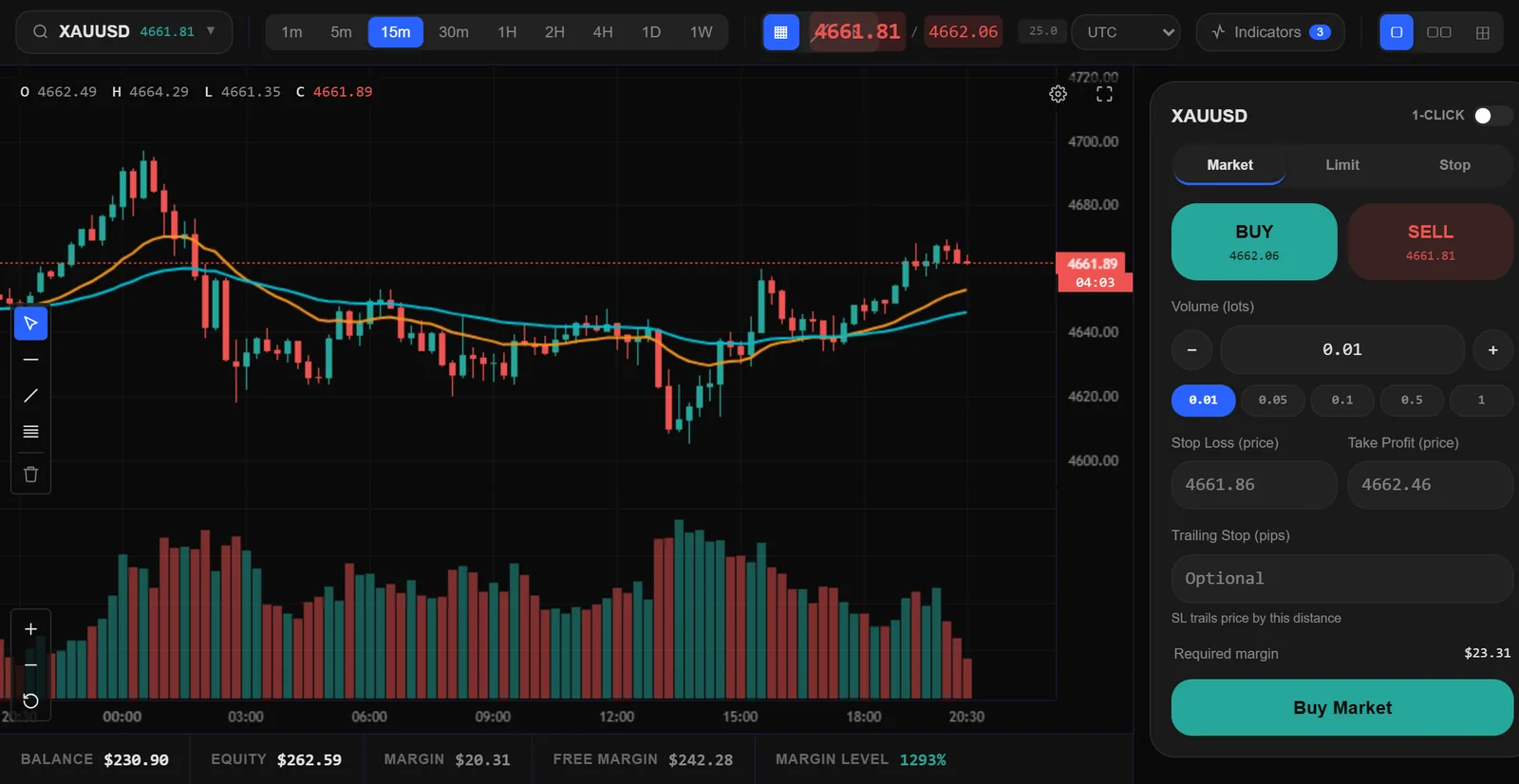
One deployment on your brand, domain and database: the terminal your clients trade on, and the CRM your team runs.
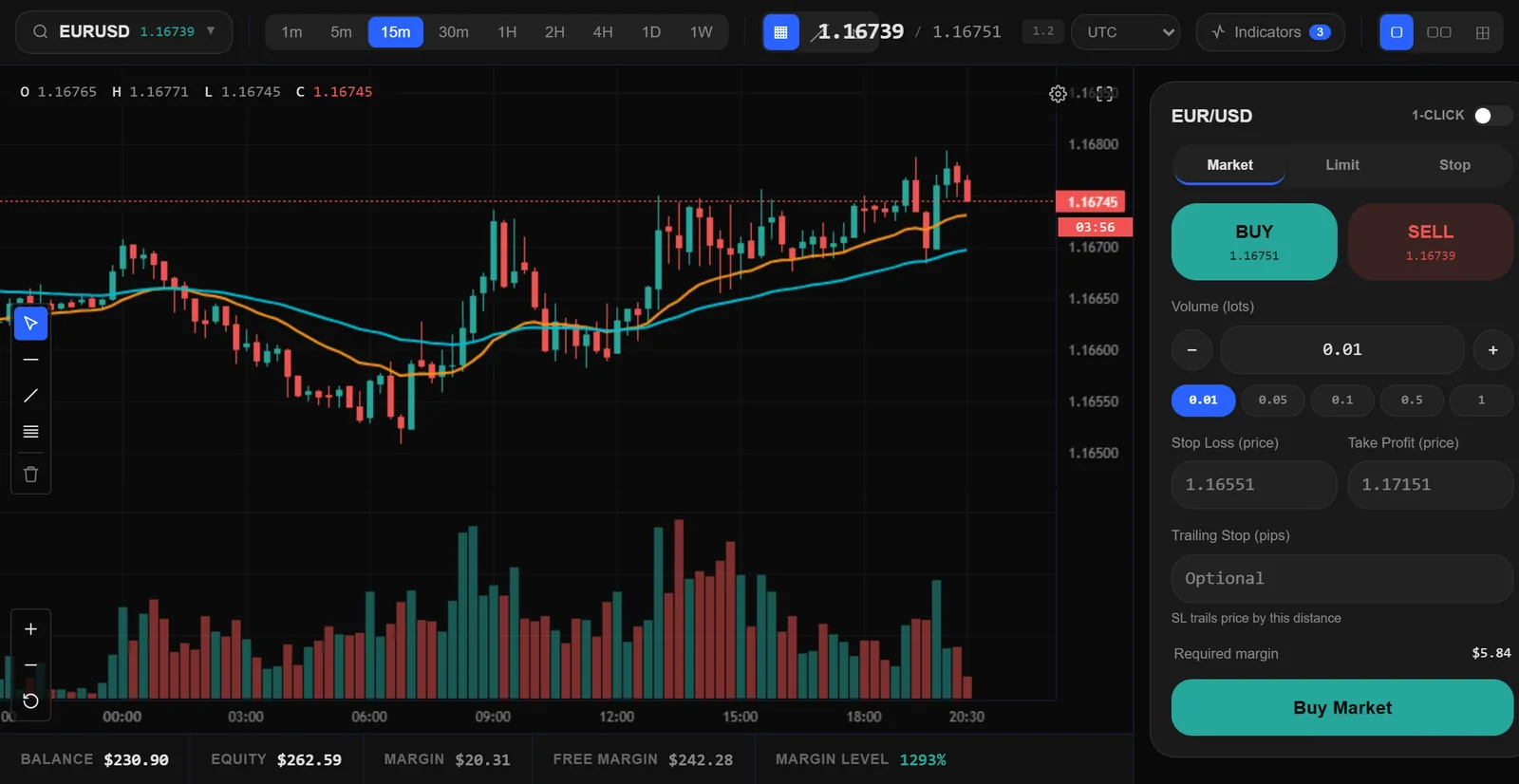
Sample market data and sample clients. "Your Brand" stands for your own name and logo.
What the Bank of Thailand says about forex businesses
The Bank of Thailand answers the question plainly in its frequently asked questions on forex.
Read moreShow less: What the Bank of Thailand says about forex businesses
It has no policy of licensing a forex business, so offering forex trading, or a service that receives or sends money to settle forex trades, inside or outside Thailand, breaches the exchange control law. A Thai company that acts as agent for a foreign broker and pays or collects money for its clients is running a foreign payment business that needs a licence, and the Bank has no policy of granting one for this.
Marketing carries its own risk. According to the same page, advertising or inviting the public to trade foreign currency for exchange rate profit falls within the 1984 law on borrowing that defrauds the public, which carries 5 to 10 years in prison, a fine of THB 500,000 to 1,000,000 and up to THB 10,000 more for each day. Collecting people's money to trade forex on their behalf is also caught by the chain scheme decree, and even trading classes can fall under the fraud law when they amount to soliciting the public.
The individual trader is treated differently. The Bank says a Thai resident may open an account with a foreign broker personally, sending money through a Thai commercial bank within USD 5 million a year, in asset types that include derivatives contracts. Its exchange control rules set the same limit per person per calendar year for portfolio transfers that do not go through an onshore agent, require registration on the Bank's website, and ask for the Bank's prior approval of payments on derivatives linked to exchange rates involving the baht. None of this lets a business in Thailand market forex to that client or handle the money, which the answers above rule out.
Warnings from the Bank of Thailand and the SEC
The Bank of Thailand's news release No. 74/2564 of 15 October 2021 warned the public that invitations to trade forex for high returns are often frauds that look like chain schemes, with no real currency trading behind them.
Read moreShow less: Warnings from the Bank of Thailand and the SEC
It repeated that foreign currency deals must be made with businesses the Minister of Finance has licensed, and that nobody other than a commercial bank or a securities company has ever been licensed to buy, sell or exchange foreign currency for investment.
The SEC's statement of 18 September 2024 is written for foreign securities and derivatives firms that serve investors in Thailand without a Thai licence. It lists conduct the SEC may treat as unlicensed business, among them a website or app with Thai-language access, payment in Thai baht, seminars and promotions aimed at Thai investors, and service channels shared with a Thai affiliate. For a derivatives business it puts the penalty at up to three years in prison or a fine of up to THB 300,000, or both, plus up to THB 10,000 a day, and it says anyone who helps an unlicensed firm faces two thirds of that penalty under the Criminal Code.
The SEC also lists firms it does not supervise on its Investor Alert page and in its SEC Check First app. A broker licensed elsewhere should expect Thai clients and partners to look there first.
The onshore route: currency futures on TFEX
Thailand does have a regulated currency product.
Read moreShow less: The onshore route: currency futures on TFEX
The Thailand Futures Exchange lists USD/THB, EUR/THB and JPY/THB futures and two cross rates, EUR/USD and USD/JPY. All five are cash settled against a reference rate published at 11:00 Bangkok time on the last trading day, and each has a daily price limit and a position limit: the EUR/USD contract, for example, uses a multiplier of 30,000 and caps a net position at 50,000 contracts.
Clients reach the exchange through a derivatives broker, which needs an SEC licence under section 16 and must keep customer assets apart from its own under section 33. The SEC's 2024 statement says an applicant first sets up a company in Thailand with paid-up capital, suitable people and working systems, that the SEC Board decides derivatives licences, and that the SEC inspects the systems before the firm opens. A group that has run securities or derivatives business abroad for at least five consecutive years, under a regulator that is an IOSCO member and a Signatory A to its multilateral memorandum, can ask for a faster review. That is an exchange brokerage passing orders to TFEX, a different business from a broker that takes the other side of its clients' trades.
Building the brokerage offshore from Bangkok
With no Thai licence available for a forex platform, founders who want the counterparty model form a licensed company in another jurisdiction and accept clients only from countries where that licence and the clients' own law allow it.
Read moreShow less: Building the brokerage offshore from Bangkok
Read against the Bank of Thailand's answers and the SEC's list of what counts as reaching Thai investors, the cautious plan leaves Thai residents out of the client terms and keeps Thai-language marketing, baht payments and local seminars out of the launch. Our overview of licence options outside the country compares the usual choices.
Funding that company is an exchange control matter as well. The Bank of Thailand's rules let a Thai company or individual invest without limit in an overseas business in which it holds at least 10% of the shares, with the money normally sent in foreign currency. In the other direction, anyone who receives USD 1 million or more from abroad must bring it into Thailand and sell it to an authorised bank or deposit it in a foreign currency account within 360 days. Settle both with Thai counsel before money moves, and use our guide to what a brokerage costs to start for the budget. This is not legal advice.
On our platform the brokerage is the counterparty to every client trade, whether it keeps the trade in-house or covers it with its liquidity provider. Pelris is not a liquidity provider and never holds client money, so the licence, the bank accounts and the payment providers all sit with your offshore company.
The terminal your offshore clients use
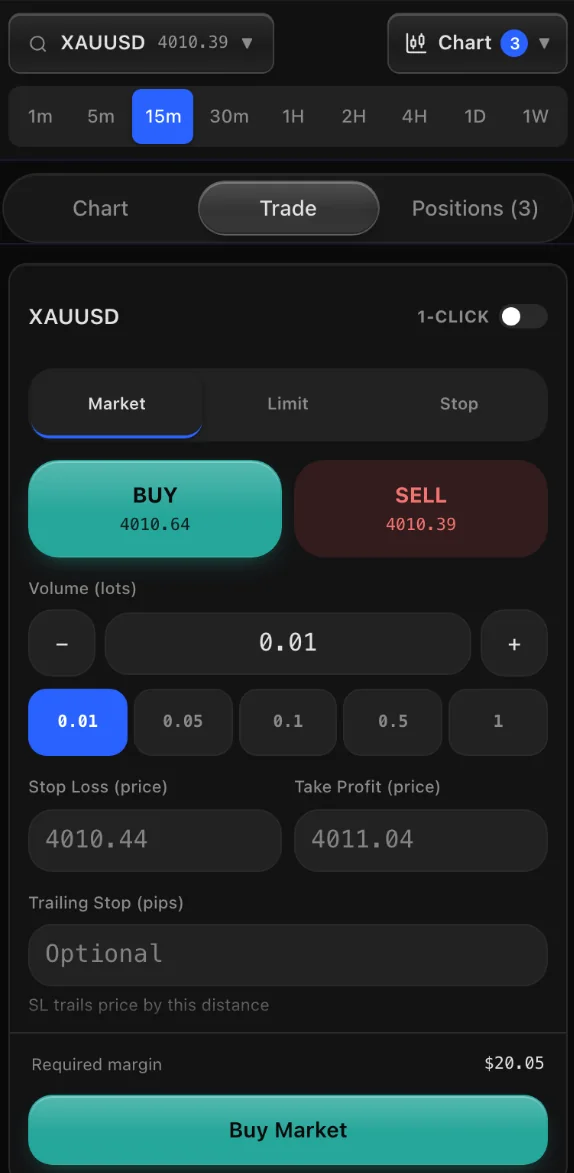
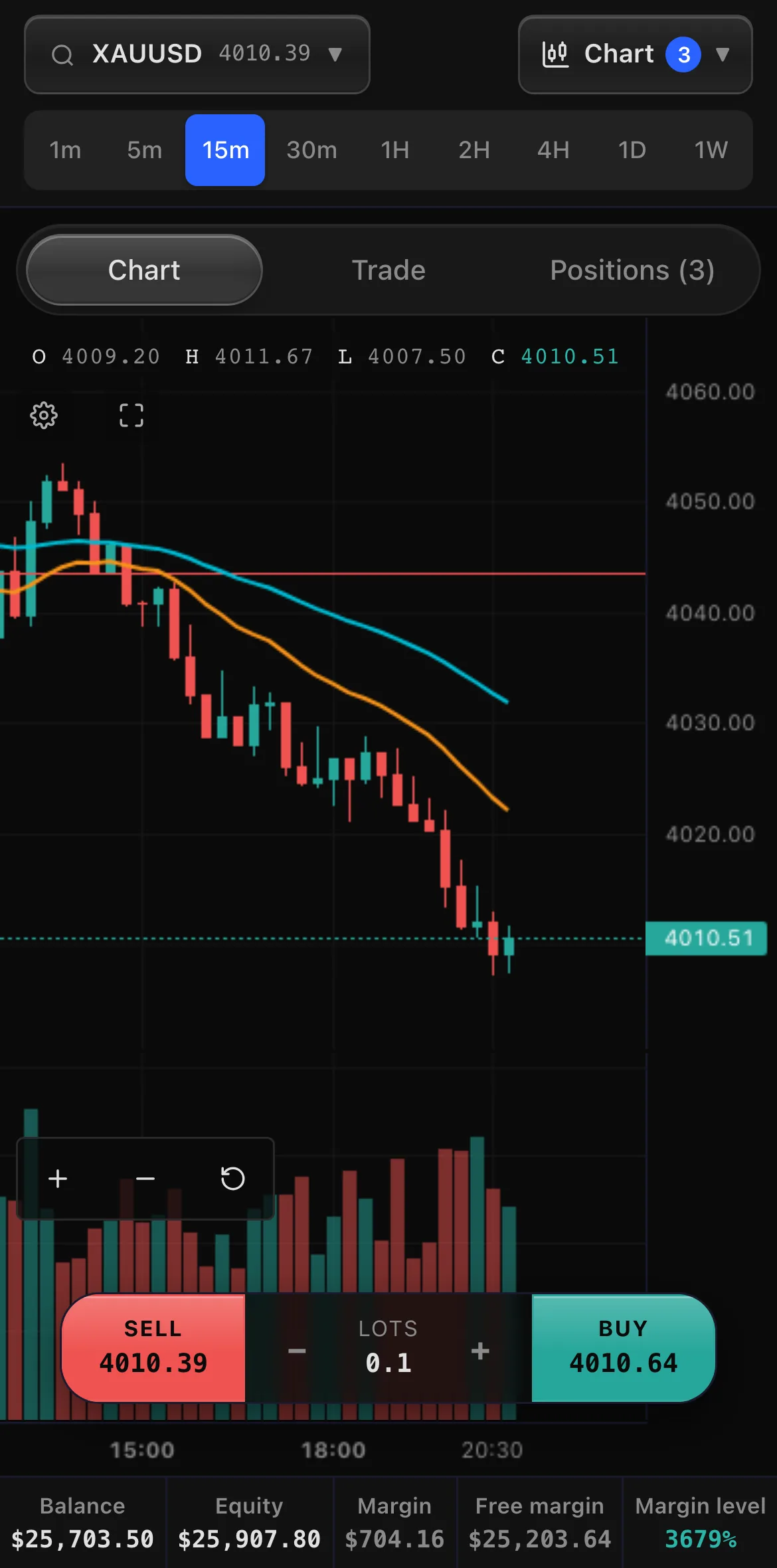
Clients get one terminal that behaves the same on a phone and a desktop.
Sample market data and sample clients.
Read moreShow less: The terminal your offshore clients use
On Android it goes onto the home screen with a single tap, iPhone users follow a short guided step, and no app store sits in between. Forex, gold and silver, oil, stock indices, crypto and US stocks are all on it, and every instrument carries its own spread, contract size and number of digits.
Because Thailand offers no forex licence to follow, the leverage limits and loss rules your clients get come from the regulator that licenses you. Leverage is set per account type and per account. The margin engine tracks live equity and free margin, sends a margin call warning and stops accounts out automatically at the levels your brokerage sets, closing the biggest loser first. If an account still finishes below zero, an admin can reset it to zero in the CRM, and that write-off stays on the record.
The CRM and the money side
Payments are where the Thai rules bite hardest, so the CRM leaves them in the brokerage's hands.
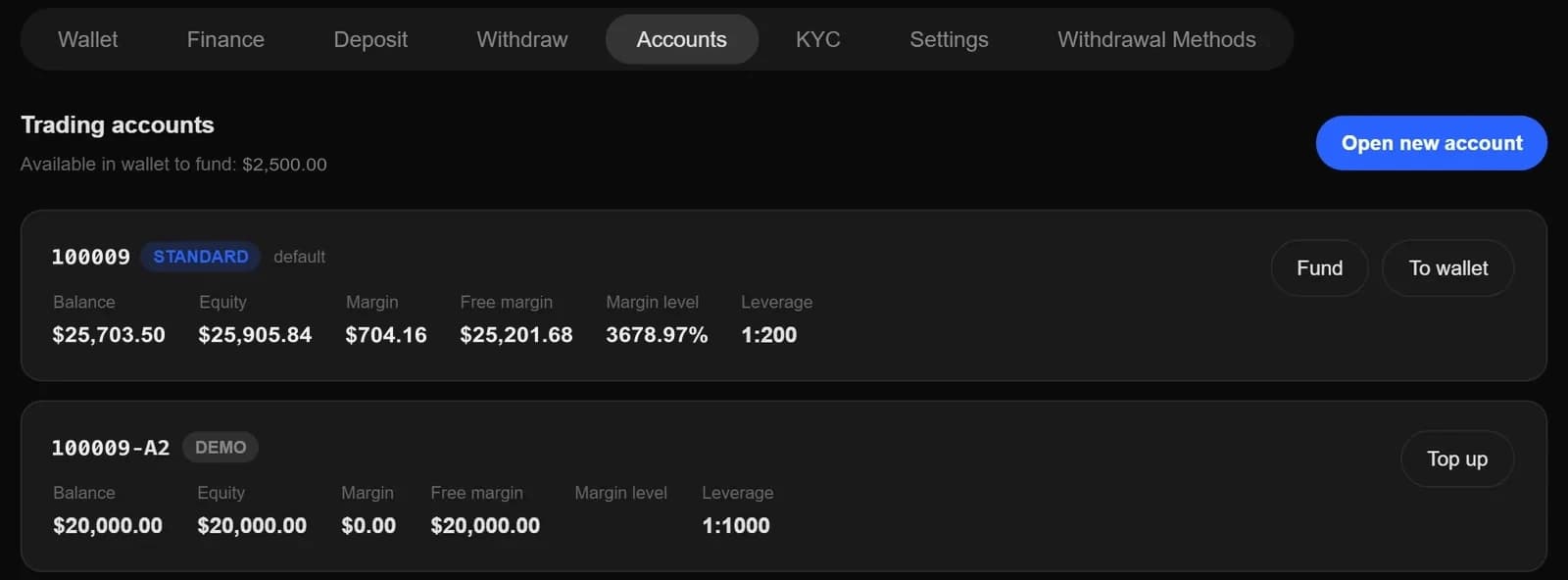
Sample data and sample clients.
Read moreShow less: The CRM and the money side
Deposits and withdrawals run instantly or through approval, against bank and payment details your brokerage sets itself, so the channels clients see are the ones your licence and your banks support. Identity documents are reviewed before any withdrawal is paid, and sensitive staff actions are written to an audit trail.
Your sales team works on your own brand: a leads pipeline that records each lead's source and who it is assigned to, a single record per client holding accounts, money, trades, documents and calls, and five roles from admin down to sales, with each agent limited to their own book. Lead sources also help compliance confirm that no campaign is reaching people your terms exclude. For the cost, see what each plan costs: one flat monthly fee, no setup fee, and the first month free.
Common questions
Anything else? Our team answers 24/7.
Is forex trading legal in Thailand?
The Bank of Thailand has no policy of licensing forex businesses, and it says offering forex trading, or moving money to settle it, breaches the Exchange Control Act B.E. 2485. A Thai resident may still use a foreign broker personally, sending money through a Thai commercial bank within USD 5 million a year.
Does the SEC license forex brokers in Thailand?
No. Section 4 of the Derivatives Act B.E. 2546 (2003) leaves out off-exchange contracts priced from an exchange rate or an interest rate, and the SEC said on 19 September 2022 that forex is not a securities, derivatives or digital asset business under its supervision.
What is the penalty for running a forex business in Thailand without a licence?
Under section 8 of the Exchange Control Act, a fine of up to THB 20,000, up to three years in prison, or both. The Bank of Thailand adds that inviting the public to trade forex falls within the 1984 law on fraudulent borrowing, with 5 to 10 years in prison and a fine of THB 500,000 to 1,000,000.
Can a Thai company collect client money for a foreign forex broker?
No. The Bank of Thailand treats paying and collecting money for a foreign broker's clients as a foreign payment business that needs a licence, and it has no policy of granting that licence.
Is there a regulated way to trade currencies in Thailand?
Yes, through currency futures on the Thailand Futures Exchange: USD/THB, EUR/THB, JPY/THB, EUR/USD and USD/JPY, all cash settled. Clients trade them through a derivatives broker licensed by the SEC.
Can a Thai founder fund an offshore brokerage company?
The Bank of Thailand's rules allow a Thai company or individual to invest without limit in an overseas business in which it holds at least 10% of the shares, normally in foreign currency. Confirm the structure, and how profits come back, with Thai counsel first.
Do you help with the SEC application?
No. We build brokerage software. Licensing, in Thailand or anywhere else, is work for lawyers and advisers, and we work alongside whoever you appoint.
Settle the platform while the licence is in progress
Book a demo to see the terminal and the CRM running on your brand, so the technology is ready by the time your offshore licence is.