The steps at a glance
Each step is explained further down the page. Steps three and six, the legal work and payments, take the longest, so start them together rather than one after another. Whether you call it starting a prop trading firm, creating a prop firm or launching a funded trader programme, the work is the same.
- 1. Understand the business model
Challenge fees come in, payouts and affiliate commission go out, and the margin between them is the business.
- 2. Choose simulated or real capital
Decide whether funded traders trade simulated accounts, real money, or both.
- 3. Form the company and write the terms
A company, a trader agreement, a risk disclosure and payout and refund rules, checked by a lawyer.
- 4. Choose prop firm software
Challenges, a rule engine, a trading terminal, live progress, payouts and a CRM for your team.
- 5. Design the challenges
Account sizes, steps, profit targets, loss limits and the optional rules that protect the firm.
- 6. Set up payments
A provider that will take challenge fees, and a way to pay the traders who pass.
- 7. Plan for payouts
Cash kept back for the weeks when many traders pass at once, and identity checks before the first payout.
- 8. Market the firm
Affiliates, communities and content, with proof that you pay.
- 9. Launch and measure
Open to a small group, then watch the pass rate, the payout ratio and the cost of each sale.
Step 1: Understand how a prop firm makes money
A prop firm, short for proprietary trading firm, sells evaluations. A trader pays a fee to take a challenge on an account of a set size and trades it under rules. If they reach the profit target without breaking a loss limit, they move to the next step or to a funded account. On the funded account they keep a share of the profit they make, commonly 70% to 90%, and the firm keeps the rest.
Most of the firm's revenue is challenge fees. Most of its cost is the profit share paid to traders who pass, plus the commission paid to the affiliates who sold the challenge. Because only a small share of traders pass, and fewer still are paid, published industry figures put payouts at roughly 35% to 48% of challenge revenue. The margin between fees in and payouts out is the whole business, which is why the rules you set in step five matter as much as the marketing.
| Line | What it is | Typical figure |
|---|---|---|
| Challenge fees | What traders pay to take an evaluation, priced by account size | The firm's main revenue |
| Payouts | The traders' share of the profit on funded accounts | About 35% to 48% of challenge revenue |
| Profit split | The share of funded profit the trader keeps | Commonly 70% to 90% |
| Affiliate commission | Paid to the partner who referred the buyer | 5% to 20% of each referred purchase |
| Payment fees | Card or crypto processing on each challenge fee | About 0.3% to 8% of each payment |
| Platform | Prop firm software with the challenge engine, terminal and CRM | About $1,500 to $5,000 a month, or a share of revenue |
Step 2: Decide between simulated and real capital
The first design decision is what a funded trader actually trades. Most challenge-based firms run both the challenge and the funded account on simulated accounts, priced from live market data, and pay the trader's profit share out of the firm's own revenue. No trader money is placed in the market, so the firm needs no liquidity provider for those accounts.
Some firms go further and copy the trades of their most consistent funded traders onto a real account funded with the firm's own capital. That makes part of the business a real trading operation, with a broker or liquidity provider, risk limits and capital of its own, and it raises licensing questions of its own. Many founders start with simulated accounts and add real capital later, once they know which traders are worth backing.
Whichever you choose, say it plainly in your terms and your marketing. The regulators' warnings about prop firms, covered in the next step, centre on traders not understanding what they are buying. On Pelris, challenge and funded accounts are simulated accounts on the same trading terminal your traders use, and the profit share is paid from the back office.
Step 3: Form the company, write the terms and ask about licences
The company costs less than most founders expect: from about GBP 100 for a UK company to around $11,900 for a Dubai free zone company in its first year, with offshore options in between. The prop firm cost guide gives the figure for each. Choose the country with your lawyer and your payment providers, not on price alone, because a payment provider that will not onboard the company matters far more than the registration fee.
The legal documents matter more than the company. A prop firm needs terms written for its model: a trader agreement that says the accounts are simulated if they are, a risk disclosure, the challenge rules, the payout and refund policy, a privacy policy and the identity checks a trader passes before being paid. A fintech lawyer drafting a full set typically charges $10,000 to $30,000.
Whether you need a licence depends on where you set up, where your traders live and what exactly you sell. Regulators have started to speak about the model. Belgium's FSMA warned consumers about prop trading firms in March 2024, pointing to paid challenges on demo accounts run by firms with no authorisation, and Italy's Consob issued a similar warning in July 2024. This guide is not legal advice: take your plan to a lawyer in your country of incorporation and in your main traders' markets before you sell the first challenge.
Step 4: Choose your prop firm software
Prop firm software is the system your traders and your team work in every day. Traders buy a challenge, trade it on a terminal, watch their progress against each rule and ask for payouts. Your team sets up the challenges, checks payments, funds the traders who pass and pays them. Every rule has to be checked on every trade, open positions included, or a breach is found too late.
Vendors sell it in three shapes: a flat monthly fee for a platform with the challenge engine and the CRM included, challenge software that you join to a separate trading platform, or a revenue share in which the vendor keeps a large part of every sale. How prop firm platforms are priced is set out line by line in the cost guide, with what each model leaves you.
Pelris is white label prop firm software on the same trading terminal and staff CRM a forex broker uses, on your own domain and your own database. It costs $1,490 a month on its own, or $300 a month added to a Pelris brokerage plan, with no setup fee, no fee per challenge sold and no share of your profit. The table shows what any prop firm software has to do, and how Pelris does it.
Do not forget the half your team works in. A prop firm CRM keeps the leads your affiliates send, a record for each trader with their identity documents, every challenge fee paid, each funded account and each payout, and roles that decide who on your desk may do what. Bought separately, it is one more system to keep in step with the challenges; on Pelris it is the same staff CRM a broker uses, with the prop desk inside it.
| Part | What it does | On Pelris |
|---|---|---|
| Challenge builder | Price, account size, one or two steps, profit targets, loss limits, trading days, a time limit and the profit split | Set per challenge, without code |
| Rule engine | Checks every trade against the rules, open positions included, and ends a challenge when a loss limit is reached | Every trade; a broken loss limit closes every open trade at once |
| Optional rules | Best day limit, maximum lot size, no new trades around high-impact news, closing before the weekend, the fee refunded with the first payout | All five, switched on per challenge |
| Trading terminal | Where traders take the challenge, on the web and on a phone | Your branded terminal, installable on a phone |
| Live progress | Shows each trader how close they are to every target and limit | Live, and an order that breaks a rule is refused with the reason |
| Fee payments | Takes the challenge fee and opens the account | Online crypto checkout opens the account by itself; bank or crypto with a receipt |
| Funded accounts and payouts | Opens a funded account for each trader who passes and pays their share | From the back office |
| Emails and certificates | Tells traders where they stand and gives them something to share | An email at every step and a certificate on passing |
| Prop firm CRM and reports | Leads, trader records, identity documents, fees collected and the pass rate | The full staff CRM, with the desk's numbers on one screen |
Sample market data and sample clients.
Step 5: Design the challenges and the rules
The challenge is your product, and its rules decide both how attractive it is to traders and how much of each fee you keep. Most firms offer a ladder of account sizes, a one-step and a two-step version, and a profit split that rewards traders who stay. Start with a small range you can explain on one page, then add sizes once you know what sells.
A common two-step design asks for 8% profit in the first step and 5% in the second, with a 5% daily loss limit, a 10% total loss limit, a minimum number of trading days and a time limit. Treat those as starting points to test, not a recommendation: tighter limits mean fewer passes and lower payouts, and looser ones sell more challenges and pay out more.
The optional rules protect the firm from the traders it does not want to fund. A best day limit stops one lucky day from passing a challenge. A maximum lot size stops a trader from betting the account on one position. A news rule and a weekend rule keep funded traders out of the price gaps that simulated accounts handle worst. Write each rule into the trader's terms and show it on their screen before they trade, so a refused order or a closed challenge never comes as a surprise.
| Rule | Sample setting |
|---|---|
| Account size and fee | $25,000 account for a $149 fee |
| Steps and profit targets | 8% in step one, 5% in step two, then a funded account |
| Loss limits | 5% of the account in a day, 10% in total |
| Trading days and time limit | At least 5 trading days, within 30 days |
| Profit split | 80% to the trader |
| Optional rules | No single day above 50% of the profit, at most 2 lots a trade, no new trades 5 minutes either side of high-impact news, positions closed before the weekend, the fee refunded with the first payout |
Step 6: Set up payments for challenge fees
Taking money for challenges is often the hardest part of the launch, so start it with the legal work rather than after it. Some mainstream payment processors list funded prop trading as a business they do not serve, so most new firms use a high-risk card acquirer, a crypto gateway, or both. High-risk card processing costs about 3.5% to 8% of each payment and usually comes with a rolling reserve held back for months. Crypto gateways charge about 0.3% to 2%.
Put the same questions to every provider before you choose a country for the company: will you onboard this business in this jurisdiction, which traders' countries can you accept, what reserve will you hold, and can you pay out as well as collect? The questions to put to every payment provider were written for brokerages, and they apply to a prop firm word for word.
On Pelris, traders can pay a challenge fee by online crypto checkout, and the challenge account opens by itself once the payment is confirmed. Fees can also be paid by bank transfer or crypto with a receipt your team checks. Card checkout is not included yet.
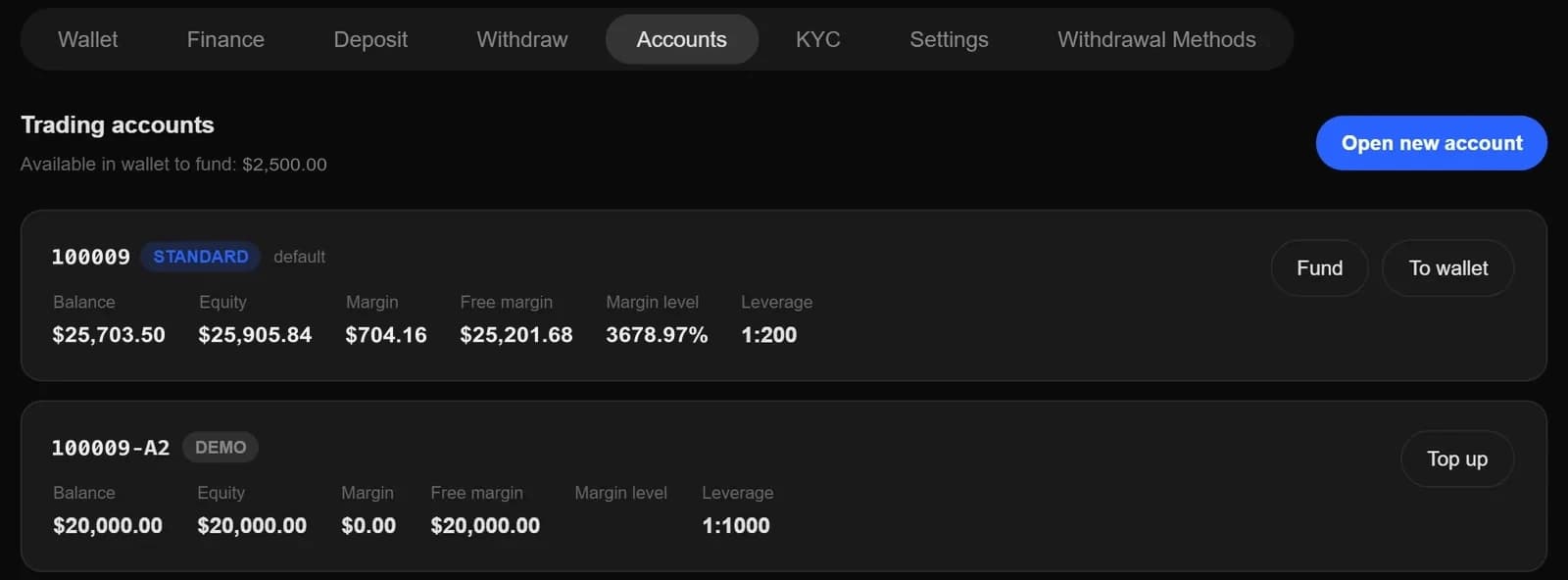
Sample data and sample clients.
Step 7: Plan for payouts before you scale
Payouts are the cost that decides whether a prop firm survives. One strong market week can bring many winners at once, and a firm that spent its fee income on advertising cannot pay them. Keep a cash reserve for payouts before you scale your marketing, and set a payout schedule that gives your team time to review each request.
Check identity before the first payout rather than at signup. Verification services charge about $0.80 to $1.90 a check, and running checks on the traders who pass rather than everyone who buys keeps the cost tied to the people you actually pay. Review each payout against the rules as well: the trades, the best day, the lot sizes and any trading around the news.
Watch three numbers every week: the pass rate, payouts as a share of fee revenue, and fees collected. On Pelris the prop desk shows fees collected, traders in progress and the pass rate on one screen, and the CRM your team works in keeps each trader's documents, payments and history in one record.
Step 8: Market the firm
Affiliates sell most challenges. Trading educators, communities and review sites refer buyers for a commission, typically 5% to 20% of each referred purchase, and a new firm competing for the same partners should expect to pay toward the top of that range. Give each partner a tracked link from the first day, so you can see which ones bring traders who buy again.
Trust is the other half. Traders choose a firm they believe will pay, so publish your rules in plain words, show that payouts are made, and give the traders who pass something to share. A pass certificate posted by a happy trader is marketing you did not pay for.
Plan around the advertising rules. Ad platforms restrict financial services ads in many countries, and an ad that reads like an offer to trade someone else's money can be refused. Do not build a launch plan that depends on paid ads running on the first day.
Step 9: Budget, timeline and launch
The fixed costs of a small prop firm's first year on Pelris come to roughly $29,600 to $51,600 before marketing and payouts: the platform, a company with an agent, the legal documents and identity checks. The full first-year budget breaks that down line by line.
The software is the fast part. Once you are happy with the demo, your branded platform is set up within a week, so it can be ready while the lawyer and the payment providers do their work. Open to a small group first, often one affiliate's community, and run every path end to end: a fee paid, a challenge passed, a rule broken, a funded account opened and a payout made.
Already run a forex brokerage? The prop firm module runs on the same terminal and CRM for $300 a month added to your plan, so you can sell challenges to the traders you already have. Starting both at once? The ten steps to a forex brokerage cover the brokerage side.
| Workstream | Typical duration | When to start |
|---|---|---|
| Company formation | Days to a few weeks | First |
| Legal documents | A few weeks | First |
| Payment providers | Weeks to several months | With the company |
| Prop firm software | About a week once you are happy with the demo | Any time; it is not on the critical path |
| Challenge design and testing | One to two weeks | Once the software is set up |
| Affiliate recruitment | Weeks, and it never stops | Before launch |
| Soft launch | A few weeks | Once payments work end to end |
Pelris builds brokerage software and is not a law firm or a broker. Nothing in this guide is legal, regulatory, financial or investment advice. Confirm your own position with a lawyer who practises in your jurisdiction before acting.